There are no items in your cart
Add More
Add More
| Item Details | Price | ||
|---|---|---|---|

June, 2026
Author:Team Btribe
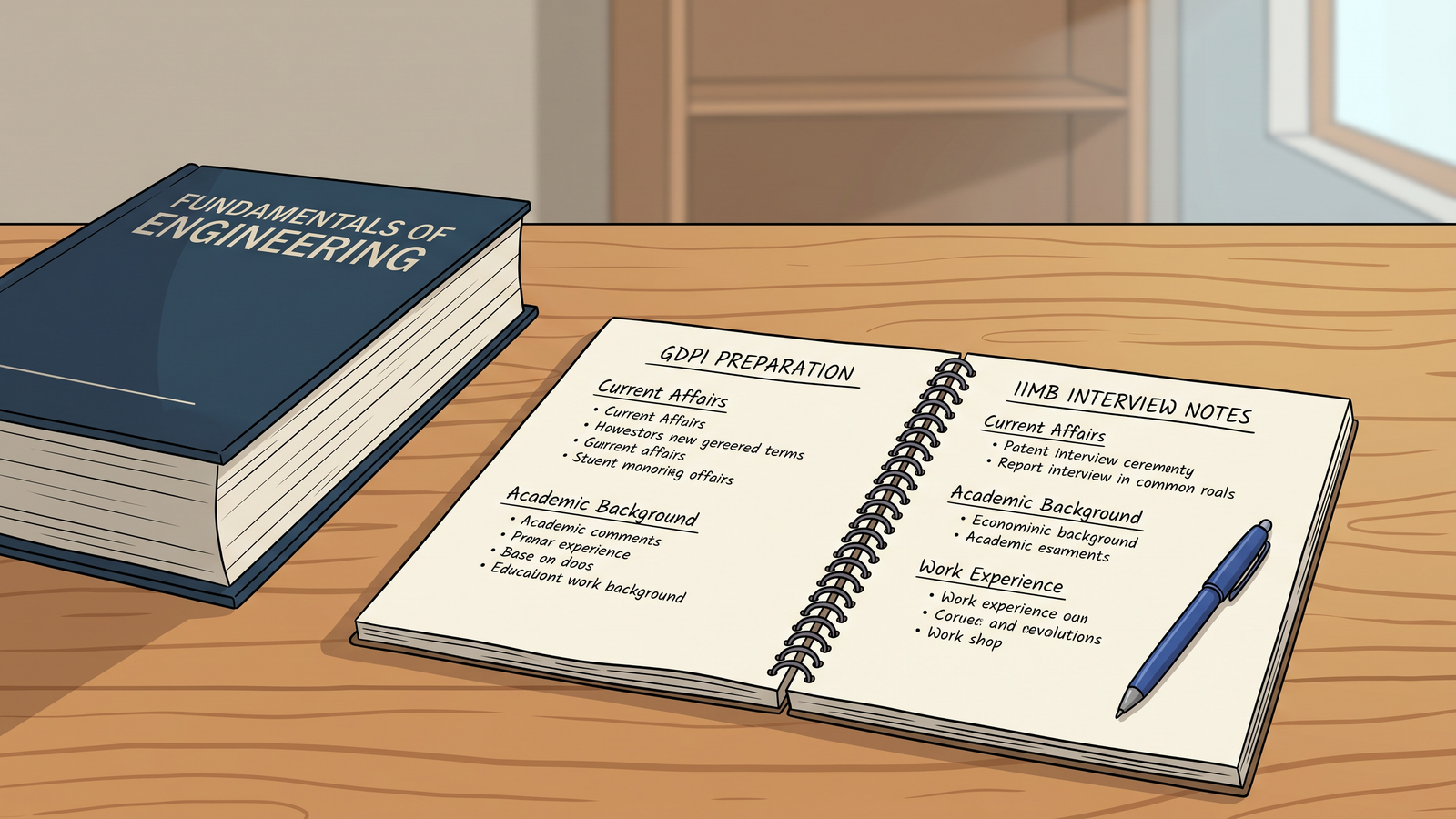
You have spent months preparing for the CAT. Between mock tests, sectional practice, and revision sessions, most of your focus has been on maximizing your percentile. Then the interview calls arrive, and suddenly the next challenge begins. Many candidates assume that interview preparation simply means practicing answers about strengths, weaknesses, leadership experiences, and career goals.
However, IIM Bangalore interviews often follow a very different pattern. For engineers in particular, the discussion can quickly move toward academic concepts, technical projects, internships, and problem-solving situations. A panelist may ask you about a subject you last studied three years ago and then expect you to explain its real-world applications. This catches many candidates off guard.
The reality is that IIM Bangalore interview questions are designed to evaluate much more than knowledge. The panel wants to understand how you think, how clearly you communicate, and whether you can apply concepts logically under pressure. Candidates who understand this early can prepare strategically and avoid the mistakes that cost many high-percentile aspirants their final conversions.

One of the biggest misconceptions among MBA aspirants is that a strong CAT score automatically translates into strong interview performance. While a high percentile proves your aptitude and test-taking ability, interviews evaluate a completely different set of skills. This is why candidates who perform exceptionally well in CAT sometimes struggle during the final stage of admissions. In fact, a thorough MBA profile evaluation often reveals gaps in communication, academics, work experience articulation, or overall interview readiness that a CAT score alone cannot highlight.
Consider Arjun, an electronics engineering graduate who scored above the 99 percentile. He spent most of his interview preparation reading current affairs articles, watching mock interview videos, and practicing standard HR questions. Since his academics had always been strong, he assumed there was no need to revisit technical concepts from engineering.
Unfortunately, his actual interview followed a different path. The panel asked detailed questions about semiconductor devices, signal processing, and one of his final-year projects. Although he remembered the basics, he struggled to explain concepts clearly and could not confidently answer follow-up questions. Despite an excellent CAT score, he failed to convert the call.
This situation is surprisingly common. Many candidates prepare for interviews as though every B-school follows the same format. However, IIM Bangalore interview questions often test academic depth and analytical thinking. Candidates who ignore these areas frequently discover their weaknesses only when they are already sitting in front of the panel.
The lesson is simple. A high percentile may help you secure an interview call, but converting that call requires preparation that goes far beyond CAT-level aptitude. Understanding the interview process early allows candidates to prepare more effectively and avoid unnecessary surprises.
Many candidates believe interview panels are primarily looking for correct answers. In reality, the evaluation process is far more nuanced. The panel wants to understand how you think, how you approach unfamiliar problems, and how effectively you communicate your ideas under pressure. Knowledge matters, but it is only one part of the overall assessment.
This is why IIM Bangalore interview questions often begin with simple topics and gradually become more challenging. Interviewers may start by asking about a project on your resume before moving into technical details, practical applications, and alternative approaches. They are not merely testing memory. They are assessing your ability to reason logically and defend your perspective.
For engineering candidates, academics often become a major focus. Interviewers expect you to understand the fundamentals of your branch, especially the subjects most closely related to your projects, internships, or work experience. If you claim expertise in a particular area, the panel will likely explore it in greater detail.
Preparing for interviews becomes much easier when you follow a structured process and prepare with the help of well-structured courses. Instead of randomly revising topics, focus on the areas most likely to be explored during the interview. The following framework has helped many candidates prepare more efficiently for IIM Bangalore interview questions.
Start by identifying the core subjects from your engineering branch. Focus on the concepts that form the foundation of your academic background rather than trying to revise every chapter from college. Mechanical engineers can prioritize thermodynamics and manufacturing, while computer science graduates may focus on operating systems, databases, and algorithms.
The goal is not to memorize formulas. Instead, aim to understand concepts deeply enough to explain them clearly. Many IIM Bangalore interview questions originate from these foundational subjects because they reveal your conceptual understanding and analytical ability.
Projects frequently become one of the longest discussion areas during interviews. Candidates often underestimate how deeply panels can explore a project listed on their resume. Interviewers may ask about the problem statement, methodology, technical challenges, results, limitations, and future improvements.
Review every major project carefully and ensure you can explain it without relying on technical jargon. Strong project discussions demonstrate ownership, initiative, and problem-solving ability. These qualities are highly valued during MBA admissions.
Knowing an answer is not enough if you cannot communicate it effectively. Many technically strong candidates lose marks because their explanations become confusing or overly complicated. A simple structure can help improve clarity significantly.
Begin by defining the concept. Then explain it in straightforward language before providing a practical example or application. This approach keeps answers organized and helps interviewers follow your reasoning. It is particularly useful when responding to technical and tricky interview questions.
Mock interviews are one of the most effective preparation tools available. They help identify gaps in knowledge, communication issues, and confidence problems before the actual interview. Candidates often discover weaknesses during their first few mocks that would otherwise have appeared during the real interview.
Consistent practice also improves composure. The more exposure you have to realistic interview scenarios, the more comfortable you become handling difficult questions. Over time, answering challenging IIM Bangalore interview questions begins to feel far less intimidating.
Many candidates make avoidable mistakes despite having strong profiles when it comes to IIM Bangalore interview questions. One common error is focusing exclusively on current affairs while neglecting academics. Although current affairs are important, technical and academic discussions often carry significant weight for engineering candidates.
Another frequent mistake is failing to review projects properly. Candidates sometimes include multiple projects on their resume but cannot explain key details when questioned. This creates the impression that they lack ownership or involvement, even when that is not actually the case.
Overconfidence can also become a problem. Some candidates assume that strong academics or work experience will automatically impress the panel. However, interviews reward preparation and clarity rather than credentials alone. Even highly accomplished candidates can struggle if they fail to communicate effectively.
A final mistake involves memorizing answers. Interviewers can usually identify rehearsed responses quickly. Since IIM Bangalore interview questions often include multiple follow-ups, candidates who rely solely on memorization frequently find themselves unable to adapt when the conversation changes direction.
Avoiding these mistakes can significantly improve interview performance and increase confidence heading into the admissions process.
Many aspirants struggle because they are unsure whether they are preparing correctly. Without expert feedback, it can be difficult to identify weaknesses or understand how interview panels evaluate responses. This uncertainty often leads to inefficient preparation and unnecessary stress.
Btribe addresses this challenge through structured mentorship, realistic mock interviews, and personalized feedback. Instead of focusing only on generic interview questions, the program encourages candidates to strengthen their academics, improve their communication skills, and prepare for technical discussions that frequently appear during interviews.
For engineering candidates, this targeted approach can be particularly valuable. The ability to explain technical concepts clearly, defend project decisions, and respond confidently to follow-up questions often determines interview performance. BTribe's preparation process is designed to develop exactly these skills.
Candidates looking for structured support for IIM Bangalore interview questions can explore our programs and gain access to resources specifically designed for MBA admissions preparation. The goal is not simply to practice interviews but to build the confidence and clarity needed to perform well when it matters most.
Explore all our courses here!
Academics often play a significant role, particularly for engineering candidates. Interviewers frequently explore core subjects, projects, and technical concepts to evaluate analytical thinking and conceptual understanding. Candidates should be prepared to discuss their academic background in detail rather than assuming the interview will focus only on personality or current affairs.
Engineers should begin by revising the most important subjects from their branch and focusing on conceptual clarity. Instead of memorizing definitions, candidates should practice explaining concepts in simple language and connecting them to practical applications. This approach is often more effective when handling technical discussions during interviews.
Yes, mock interviews are one of the most valuable preparation tools available. They provide realistic interview exposure, reveal weaknesses, and help candidates become more comfortable responding under pressure. Consistent practice also improves confidence and communication skills significantly.
Interviewers do not expect candidates to know everything. If you are unsure about an answer, it is better to acknowledge the limitation honestly and explain your thought process. Attempting to bluff usually creates more problems than admitting uncertainty.
Project discussions can become extremely detailed. Candidates should be prepared to explain objectives, methodologies, technical decisions, challenges, outcomes, and future improvements. Any project listed on your resume is a potential area for in-depth questioning.