There are no items in your cart
Add More
Add More
| Item Details | Price | ||
|---|---|---|---|

May, 2026
You get the shortlist. You have read every case framework book available. You have solved fifty practice cases on your own. And then you sit across from a McKinsey partner, open your mouth to structure the problem, and freeze.
Not because you do not know the answer. Because you have never done this under real pressure, with a real person watching, when it actually counts.
That gap between knowing frameworks and performing them is where most consulting placements are lost. The good news: it is entirely closeable before your first interview, if you train the right way.
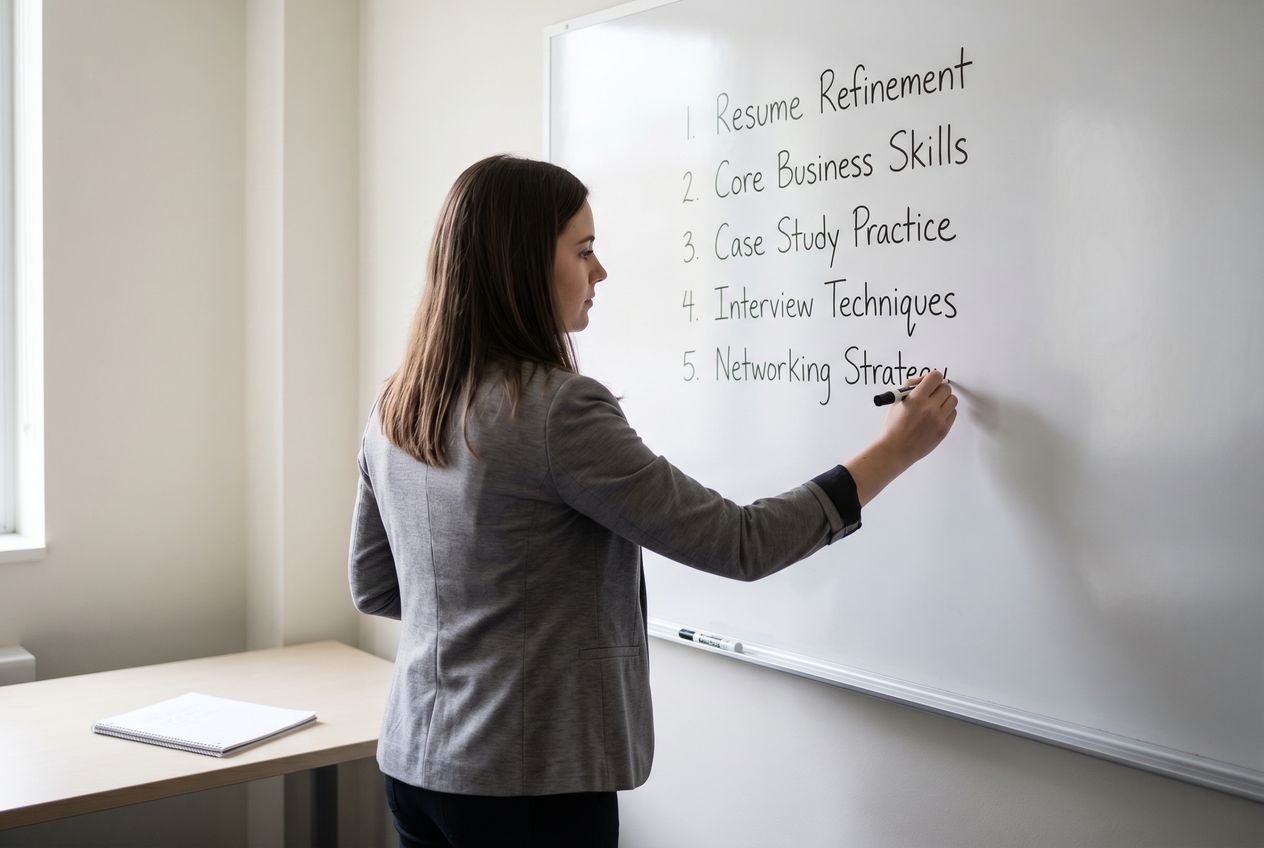
By the end of this, you will know:
Every MBA student targeting consulting knows they need to prep cases. That part is not a secret.
What is less obvious is how most students prep, and why it produces mediocre results even for smart, hardworking people.
Most consulting placement preparation looks like this: read a case book, solve cases alone or with one friend, watch YouTube videos on frameworks, and assume that repetition will eventually make it feel natural. It does not.
Practising cases without expert feedback is like practising a presentation in front of a mirror. You get comfortable. You never get better.
Priya was a second-year student at a Tier-1 B-school targeting McKinsey for her final placements. She had solved over 80 cases before the interview. In her mock PI with a bTribe mentor, she realised she had been structuring every case the same way: profitability tree, market entry, M&A, regardless of what the prompt actually asked. She had memorised templates, not thinking.
Two weeks of deliberate, feedback-driven practice completely changed how she approached problem structuring. She converted her final placement offer.
The difference was not volume. It was the quality of feedback on each attempt.
Most MBA summer internship interview questions are designed to test three things. Most candidates only prepare for one.
Here is the uncomfortable truth: most consulting preparation in India focuses almost entirely on case structure. The communication layer and PI depth get 20% of preparation time and determine 50% of the outcome.
There are two types of consulting preparation most MBA students use. Understanding the difference between them is the most important thing in this post.
A framework is a starting point, not an answer. The candidates who convert know how to adapt frameworks to the specific problem in front of them. They do not apply a template and hope it fits.
Someone who has been on the other side of the table, an IIM alumnus who has interviewed at McKinsey or a Top 10 B-school senior who converted Bain, watches you solve a case and tells you exactly where your logic broke down, where your communication became unclear, and what the interviewer is actually thinking.
That feedback loop is what separates candidates who convert from candidates who keep reaching the final round and losing.
Rahul was targeting BCG for summer placements. He had strong quant skills and a clean case structure. His problem was pacing. He rushed to build his structure within 30 seconds of hearing the prompt, before fully understanding the problem.
His BTribe mock PI mentor caught this in session two of ten. By session six, Rahul had built the habit of pausing, clarifying, and then structuring deliberately. He converted BCG.
The ten mock PIs were not ten repetitions of the same thing. Each one built deliberately on the feedback from the last.
The BTribe A Game Combo 1A is built around four components that work together. Here is what each one does in the context of consulting placement preparation.
This is where domain depth gets built.
The ELP Consulting track covers intermediate to advanced consulting frameworks through live sessions, not recorded lectures you watch alone late at night. You work through real business problems in a structured environment, apply frameworks to live cases, and complete a live project with bTribe that produces a tangible CV point you can reference in interviews.
The live project matters more than most students expect. When a McKinsey interviewer asks you to walk them through a recent project where you applied structured thinking to a business problem, "I led a live consulting project with bTribe where I analysed X market and recommended Y" is a specific, credible answer. "I read Case in Point" is not.
This is the feedback engine.
Ten one-on-one mock personal interviews, thirty minutes each, with IIM alumni and Top 10 B-school mentors who have been through the exact process you are preparing for. Not peer practice. Not self-evaluation. Mentors who know what McKinsey, BCG, and Bain interviewers look for because they have sat in those rooms themselves.
Beyond mock PIs, the bootcamp covers:
Consulting placement preparation and case competition preparation overlap significantly. Both require structured problem-solving under pressure, clear communication, and the ability to synthesise ambiguous information quickly.
MBA Pro builds this through live case competition participation. You work through 10 to 15 real case competitions released by corporates during your MBA, with mentorship on each attempt. An internal competition at the start simulates the pressure of a live case comp before the stakes are real.
Students who compete in national case competitions before placement season consistently report that the experience changes how they feel in consulting interviews. The pressure of a real case comp, with a real deadline, real judges, and a real outcome, is a closer simulation of a consulting PI than any solo practice session ever will be.
The AI Accelerator covers how consulting firms are actually using AI tools in their work, and how to discuss this credibly in a PI.
"How do you see AI changing consulting?" is a question appearing in McKinsey, BCG, and Bain interviews with increasing frequency. Candidates who answer it with specific, informed examples stand out sharply from those who give generic responses about automation and efficiency.

This is worth addressing directly because it is unusual, and unusual claims deserve honest explanation.
The A Game Combo 1A includes a 50% refund if you do not convert any of your on-campus placement opportunities. This applies when you complete three specific milestones: submitting your ELP project by the deadline, completing at least five mock PIs before your first placement interview, and getting your CV, HR answers, and Master Profile Builder approved at least three days before your first interview.
The conditions matter as much as the guarantee itself. They are not fine print. They are the preparation checklist.
A student who completes all three has done a live project, practised mock interviews with expert feedback, and had their CV reviewed by a mentor. That student is genuinely prepared. The guarantee exists because bTribe is confident in what structured, feedback-driven preparation produces.
The most honest way to read any placement guarantee is not as insurance. It is as a checklist that tells you exactly what being prepared actually looks like.
Strong fit:
Weaker fit:
Most MBA students spend three to four months preparing for consulting placements. Here is what that time actually looks like across the two approaches.
The difference is not how many cases you solved. It is the quality of signal you received on each attempt.
Students from past bTribe cohorts who completed structured placement preparation, including mock PIs, CV review, and domain sessions, converted offers at McKinsey, BCG, Bain, Kearney, and Roland Berger, as well as top FMCG firms, investment banks, and general management roles.
The detailed outcomes are on the BTribe testimonials page, with named students, specific firms, and specific roles. Not aggregate statistics. Individual stories you can read and judge for yourself.
What the results consistently show is not that bTribe made the placement happen. The students did the work. What changed was the quality of their preparation: specific feedback on specific weaknesses, applied consistently over time.
Start at the beginning of your first trimester, ideally before placement committees begin evaluating students. Consulting shortlists at top IIMs move quickly. By the time case competition registrations open and firms begin early engagement on campus, students who have been practising for two to three months already have a meaningful edge over those just starting.
Case interview preparation covers frameworks and problem-structuring, which is the analytical layer. Consulting placement preparation is broader. It includes the PI, which tests your story and cultural fit; the GD, which tests communication and leadership under group pressure; your CV and applications, which determine whether you get the interview in the first place; and domain knowledge, which is what you discuss when the interviewer goes beyond the case. You need all four layers to convert. Most candidates only prepare one.
Feedback quality matters more than volume. Ten structured mock PIs with expert feedback produce better outcomes than thirty peer mock PIs with no meaningful correction. The A Game Combo 1A includes ten one-on-one mock PIs with IIM alumni and Top 10 B-school mentors, which is the right number when each session builds deliberately on the feedback from the last.
Yes. Top consulting firms in India actively hire freshers for associate roles because they value structured thinking and learning agility over prior industry knowledge. What freshers lack is professional story depth and domain context, both of which can be built through the ELP live project and the PI preparation in the bootcamp. The gap is real. It is also closeable before placements begin.
Practising GDs with batchmates is useful but limited by what your batchmates know. bTribe mock GDs include regular, abstract, and chairman GD formats with mentor observation and specific feedback on your participation quality, not just your content. The chairman GD format, where you are expected to facilitate, synthesise, and conclude, is a skill that almost no one has practised before their first real round.
The A Game Combo 1A includes a 50% refund guarantee for students who complete all three milestones: submitting the ELP project by the deadline, completing at least five mock PIs before their first placement interview, and getting their CV and HR answers approved at least three days before their first interview. Read the conditions carefully before enrolling. They are the preparation checklist, not just fine print.
If you are targeting consulting placements at McKinsey, BCG, Bain, Kearney, or any top-tier firm, and your current preparation does not include anyone watching you solve a case and telling you specifically what is wrong, you are missing the layer that converts shortlists into offers.
The A Game Combo 1A is built to close that gap. Ten structured mock PIs with IIM alumni mentors. Iterative CV and application review. Company-specific preparation material. A live consulting project that gives you a specific, credible story for the PI room.
Review the full program details and past student results at the BTribe store. Then make one honest assessment: is anyone in your current preparation telling you specifically what to fix?
If not, that is what needs to change before your first interview.
The shortlist gets you into the room. Everything after that depends on what you do when you are in it.
BTribe